8.30.2007

The Well Tuned Bin Flipping Experience


Bob Burnett: A kind c60 reader has graciously made a copy of LaMonte Young's The Well Tuned Piano available to me for which I am ever thankful.

I realized while I was flipping through tons of stacks of CDs this past week in the Bay Area that even after 30 years the music store environment is still an exciting place for me to be in and how appreciative I am for all the retailers who keep making the "browse the bins" experience happen. I don't think I'll ever be completely satisfied with the download or online experience. Don't get me wrong--it sure is nice to have as an option---but nothing matches the buzz of walking in a well-stocked shop with a staff who know their stuff. I've been to a bunch of music places over the years and try to mention favorite haunts (such as NYC's Downtown Music Gallery and Other Music, Amoeba Music in the Bay Area and LA, Melody and Olsson's in DC) when it seems right.

So, as a c60 "public service" please mention your favorite shops or new discoveries as you go from place to place so we can all go to them too when we travel.

8.29.2007

Guy Klucevsek/Bantam Orchestra:Stolen Memories


Bob Burnett: I've just spent the last few days in the bay area and made swings by Amoeba Music in San Francisco as well as Berkeley. I picked up a wide range of things--from Neil Young & Crazy Horse to a Criterion DVD of Grey Gardens. I'm sure your own personal bin scanning and buying excurions to great stores like Amoeba brings you offerings performed on guitar, piano, possibly saxophone and maybe even a theremin or two--but how're ya doing with accordion? Now you can say "well--quite well thank you! I just bought some Guy Klucevsek and the Bantam Orchestra!" I've been meaning to mention this album for some time. Yesterday, I flipped by it in a bin and reminded myself to write something up because it's something to keep an eye out for.

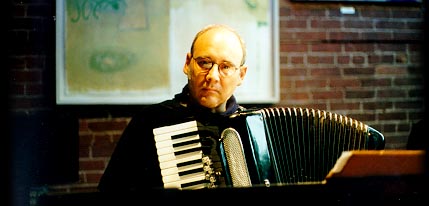
Guy Klucevsek is a master of the Titano Royal Converter Piano Accordion --he's comfortable playing "straight" but where he really shines in his ability to bring the avant garde to the accordion. He's been a "downtown music" guy for a long time-playing with innumerable players in NY's adventurous music scene. If you want to know more check out his webpage. One album in particular that I enjoy is Stolen Memories which is a quartet that goes by the name Bantam Orchestra. The Bantams include Achim Tang on bass and sisters Sara (violin) and Margaret (cello-voice) Parkins along with Klucevsek on accordion, piano and melodica. Stolen Memories is a chamber effort--it moves effortlessly from soft, floating klezmer music to minimal avant garde-tinged compositions. "Wave Hill" is a particularly striking Eno-style composition where chord patterns and melodies gently overlap in a peaceful manner. I also enjoy Tesknota (for John Cage) a long, fluid, drifting composition. In fact, since we're on accordion and John Cage, Teodoro Anzellotti created Three Compositions by John Cage, a beautiful solo take on Cage that I suggest looking into too if you enjoy Cage solo piano such as Sonatas and Interludes or The Seasons.

Time to catch a Jet Blue plane and watch the US Open.

8.22.2007

Enrico Rava: Tati


Bob Burnett: (with apologies to those flooding in the midwest) It finally rained in the Washington, DC area. It has been dry and dusty all summer. Thank goodness for the rain.....I can now play "rainy day music" and Tati qualifies as such. Tati is a trio made up of trumpeter Enrico Rava, pianist Stefano Bollani and stalwart c60 living legend Paul Motian on drums. This, being an ECM album, means there are very telltale ECM qualities about it--stark but clear compositions, rich sound, room-filling (but thankfully subtle) echo. I happen to like "that ECM kind of stuff" so it works for me.

Enrico Rava has had a 40+ year career in jazz. He's most known for his steady Miles Davis meets Chet Baker-rooted playing with a variety of people such as Gato Barbieri, Mal Waldron, Steve Lacy and Roswell Rudd. I've always found his sound and Kenny Wheeler's to be similar in nature. ECM's Manfred Eicher first discovered Rava in the early '70s and was on several of that era's albums. Tati was released in 2005 and was the follow-up to 2004's Easy Living, his first ECM album in 30 years. The trumpet-piano-drums trio format on this album creates an interesting dynamic; it's a spacious, and spare effort. The players are able to restrain themselves quite well, add punch when it counts and never lose focus on keeping the "calm waters run deep" ECM-style of playing intact. The album mixes original compositions (by Rava as well as Motian and one by Bollini) with a couple of interesting covers. Tati opens with a beautiful take on George and Ira Gershwin's "The Man I Love" and they also perform a rendition of Puccini's "E Lucevan le Stella" from the opera Tosca.

This is the first time I've had extended exposure to pianist Stefano Bollani--and I really like what I hear. He seems rooted in the Bill Evans/Keith Jarrett lineage however he is able to find his own voice and has an admirable ability not to overplay--reminiscent to me of the ECM recording Storyteller Marilyn Crispell did with bassist Gary Peacock and Paul Motian. I discovered Bollini has an album of solo piano on ECM; I just ordered it to further explore his body of work.

Manfred Eicher produced Tati however, instead of it being recorded in Tonstudio Bauer like many ECM albums it was done in New York's Avatar Studio--(I stuck an image from their webpage on the right---nice!) and I really like the sound. There is something "live"about the environment of Avatar Studio that sometimes gets lost in the sonics of other ECM albums. One slight indiscretion from my perspective is that Paul Motian at times seems buried in the mix--granted, I like the "sound" of the drums. I'm a big fan of Motian's textured playing so I'm always looking to hear every color in his approach to a composition.

Ah well---in the big picture I'm not complaining; I really enjoy how this group gels . Plus, there are plenty other opportunities in my ever-growing stack of Motian cd's to make up for this one's low-key approach.

8.18.2007

John Lennon: Acoustic

"Okay, so flower-power didn't work, so what? We start again." —John Lennon, on Acoustic

Mike Johnston: Apple (the computer company) obviously just reached an agreement with Yoko Ono, because John Lennon's entire solo catalog has just gone up on iTunes.

This seems like an event, but I'm not sure. I bought a handful of these albums when they were new and listened to some of them heavily (although some of them, such as Menlove Avenue, I had never heard once), but it was hero-worship more than anything else. I liked the anger, too, I think. Plastic Ono Band in particular is not nearly as good in retrospect as I thought it was at the time; Bob says it "worked when he made it because it was just the cathartic album he needed to make at the time," and he's right, but it seems like a period piece now. I'm not saying it doesn't hold up at all, but it's not as powerful now as it was then.

It's interesting how little of John Lennon's solo output I've forgotten, considering that most of it is forgettable. All of it is very spotty—as songwriting, as singing, stylistically, and in terms of production.

I recommend the new Acoustic compilation, however, which I bought. It's generally terrific. Some of it redefines the "lo" in "lo-fi," aspiring to but not reaching the standard of cheap demo-tapes, but the roughness and simplicity helps; it reminds us that we're listening to a ghost. Nice time capsule and some interesting takes on semi-familiar tunes. Most of it was probably recorded on the cassette deck Lennon allegedly carried around to "jot down ideas" on, although a few might have involved an actual microphone, and there are a couple of live things probably from bootlegs. Nothing fancy anywhere.

The song choice on Acoustic is good. It's painful to listen to John's Yoko-isms on "Cold Turkey," but then, that was all part of the gestalt of the whole post-Beatles scene back then. Of course it contains a version of "Imagine," which is Lennon's "Yesterday." (Though not as good.) "Imagine" is one of those horrible afflictions that you like when it is new, quickly get tired of, then arrive at the point where you definitely never want to hear it again...and then have to listen to it 400 more times, because it's everywhere and you can't fucking escape. On Acoustic it's the inevitable encore that the audience won't be talked out of—so just "imagine" all the happy pseudo-fans swaying along to the quasi-Utopian, faux-commie treacle and smile. Or program it out.

The only solid criticism of Acoustic I can think of is that Lennon wasn't a very good acoustic guitarist. Not as good as someone like, say, Willie Nelson, who is similarly known as a songwriter and singer and not as a guitarist. Most of Lennon's guitar work here falls into the category of "strumming along."

John Lennon's solo career is very similar in my book to Michael Jordan's career after the Bulls' sixth championship. Unnecessary, for the most part, and yet you follow it because, well, he was John Lennon. While not really a success, it's noteworthy in that it wasn't worse. And while it would have been good for the legend if he'd abruptly left music altogether at the pinnacle of his game, on the other hand you really don't begrudge him his subsequent labors—posturings, missteps, and failures and all. He earned it.

I just don't like to imagine Lennon in Las Vegas, like old Elvis, in a white suit. (There are worse things than death.) It could have happened, too—Lennon always had that goofy, spoofy undercurrent to him. And maybe he would have steadied his wavering musical compass if he'd lived. Frankly, it wasn't looking that way. What I like to "imagine" is something else Bob suggested—that he would have reinvented himself, and found something entirely new to do, outside of music altogether. It's a thought.

Sonny Clark Trio

Mike Johnston: One of the nice discoveries for me in writing my Max Roach obituary yesterday on The Online Photographer is that the generically-titled Sonny Clark Trio (Time T 70010) is available on iTunes. Sonny Clark (full name Conrad Yeatis Clark) was one of the many that jazz lost young, dead of a heroin overdose at 32. Generally a sideman, his reputation has done nothing but grow over the years. I have his Connoisseur releases (Sonny's Crib and Dial 'S' for Sonny, the latter now an RVG with the original cover restored—it was one of the first sessions, if not the first, that Rudy Van Gelder recorded in stereo), and Clark's Cool Struttin' is to me one of the high points of '50s jazz, a must-own album (and no, I am not just into high heels). But I've never owned T 70010 till yesterday.

I've always been into piano. I love Sonny Clark's spiky, complex, but melodic style of playing, which seems to me full of ideas while at the same time staying unpretentious at all times. This album as a whole is a nice, relaxed high-style hard bop date (if you're not up on your jazz terms, "hard bop" is, despite what you might assume from the name, a gentler, more tuneful, easier-to-listen-to evolution of bebop), equally useful as background or up-front listening—merely a very good record, but from a truly great period.

Unlike Tin Hat Trio and Tied & Tickled Trio, Sonny Clark Trio really is a trio. Clark is joined by George Duvivier on bass, who's very solid and contributes several solos, nicely projected, and of course Max Roach on drums, which is how I got here. There are four alternate takes, none of which are quite as smooth as the album selections, which to me seems to improve them, if only marginally. If you just want a taste—of the album, not just the alternates—try "Nica (Alternate Version)," which swings with rough edges and spirit from Sonny. Listen to it kinda loud so you get the percussiveness of the piano. If anyone, it's Max Roach who's reticent on this record, although as usual you can't fault his tasteful gentility. Apart from some tape hiss, the recorded sound is on the high side of fine.

Sonny Clark recorded a lot if you're willing to look for him on other peoples' records, and he died just before the Beatles and the "British Invasion" dealt a body-blow to the popularity of bop. (It's never good to die young, but at least Clark's timing was right.) He didn't pack as much into half a lifetime as Lee Morgan did, but then again he left us a lot more than Tina Brooks (another heroin tragedy) was able to. I'm pleased to have this addition to his legacy.

8.16.2007

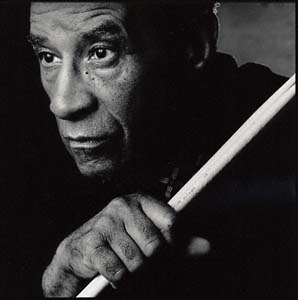
Max Roach: RIP


“You can’t write the same book twice. Though I’ve been in historic musical situations, I can’t go back and do that again. And though I run into artistic crises, they keep my life interesting.”

--Max Roach

8.15.2007

Albums I Spent Years Looking For........

Bob Burnett: I figured I'd digress from the normal routine of writing about albums I have and recount some stories about albums I wished I had and looked for--sometimes for years--sometimes with success and sometimes with longing heartbreak. In the internet/CD/re-release era we live in the thought of having to search out albums in a quixotic manner from store to store is now a slightly archaic, albeit glimmery warm and Proustian reflective consideration. Oh well, I'll share some of mine. Feel free to jump in with yours, too.


Chappaqua Suite: Ornette Coleman I first heard about this album while working in Haffa's, a record store in Athens, Ohio, in the early '80s while in college at Ohio University. The store's owner, and fellow Ornette Coleman afficionado Ron Esposito, was purported to have a coveted pressing of this rare gem--however I never saw or heard his copy played--I only heard his hushed, respectful reference to it. The reason it was so coveted was because it was a long out-of-print, Europe-only release of a rejected soundtrack for the film by Conrad Rooks. I looked for this one for about 15 years. I finally got it as a reissue on CD--which is once again out-of-print and on Amazon for $65 used.

Fly: Yoko Ono This was another fascinating mystery album for me in the early '80s because it was purported to be a difficult listen and because Yoko Ono annoyed everyone. Plus, it was a two album set which I found commendable in a Metal Machine Music difficult listen kind of way. I looked for this one for a number of years and finally found it, for something like $30 and played it a few times.....and now have no memory of it whatsoever. Ah....well....it's easily available now for about $20 re-issued on CD. Seems that makes it too easy to even return to.


Lumpy Gravy: Frank Zappa I heard a French pressing of this gem in the '70s while in high school and was smitten. I loved the layers of sound, abstract "fly on the wall" dialogue, clanging percussion, noise, chaos, rapid changes. This was when Zappa was known mostly for Apostrophe by a certain minority of shaggy, semi-geeky-but-hip Marlboro and weed smoking high school boys--and in the case of my high school by one additional girl known as "Susie Creamcheese". I finally found this one and dropped $25 of hard earned $2.35 minimum wage salary at the Long John Silver's on this one. I later sold the vinyl version for a profit and replaced it with a CD version.

LaMonte Young: The Well Tuned Piano My biggest heartbreak. I had the vinyl box set. Some time ago I was liquidating a substantial part of my vinyl collection and I sold it thinking it would be easy to get on CD. I was wrong. I've never been able to find it. I even wrote Gramavision and begged them to sell me one--after all it was discontinued from their catalog and surely there must be a few in some warehouse. Nope. Oh--in case you were curious, it's available on Amazon for only $850 used. The only thing I ever was able to recover was about 52:00 of it off of Napster. Thank you benevolent law-breaking soul who illegally posted that for me.