2.10.2008

Willits+Sakamoto: Ocean Fire


Bob Burnett: This morning I delved into Other Music's digital page to discover a new collaborative effort that I was interested to hear. Ocean Fire is a duet improvisation between "digital age"guitarist/custom-built software player Christopher Willits and composer/synthesist/pianist Ryuichi Sakamoto. The duet works from the perspective of creating a soundtrack for the ocean and does so with immense washes of sound that ebb and flow in a manner like the tides. There are natural connections here to Sakamoto's duet works with "the other" digital age guitarist Christian Fennesz, however this collaborative works in a non-defined sound sculpture mode more than a formal chordal compositional approach. I'm finding great attraction to Christopher Willits' contributions on this album--in fact it led me to explore a few of his solo offerings, most notably the excellent solo abstraction Folding, and the Tea as well as the much more linear Surf Boundaries. Willits comes with an impressive resume--notably a Mills College Master's degree where he studied under the tutelage of c60 stalwarts Pauline Oliveros and Fred Frith. Before Mills he was active in a wider range of creative outlets including video art, sound art/installation, painting and music.

I'm finding great excitement in the listening experiences offered by the current generation where the guitar and keyboard are being redefined as genre-breaking instruments crossing multiple platforms of exploration and legacy. It's engaging to see how the generations of sound designers continue to evolve--that which was first noticed in 1948 with John Cage using alligator clips and other hardware store devices on the strings of a piano for Sonata and Interludes to Fred Frith's early '70s work which expanded textural and rhythmic qualities possible for guitar to this generation's developing new approaches works to open the doors to further possibility. Ocean Fire is a great addition in the legacy of improvisation and sound expansion.

2.05.2008

dublab just played Luna and The Sea and Cake

Bob Burnett: I just started listening again to the online "radio" music environment dublab. For any number of reasons dublab fell off my listening list for awhile after a long run of enthusiastically enjoying what they were about. Well, a few stars just aligned for me--the show I stumbled upon today was called "The Heavenly Music Corporation" which is Fripp and Eno code for "oooh what a great album". The second reason was the "Heavenly" DJ played a great Luna instrumental from the Luna EP release as well as back-to-back cuts by The Sea and Cake.

I fell back into dublab because I discovered Jimmy Tamborello (aka electronica musician/curator Dntel as well as Postal Service) is a regular program host of the program "Dying Songs". There is currently an archived program of his that starts with a cut by The Durutti Column. I can't recall the last time I heard a Vini Reilly/Durutti Column cut on "the radio"; probably in 1982 when most likely either Kim or I played one on a radio show someplace.......also.....I am becoming fond of the most recent Dntel CD Dumb Luck. As is usually the case with Dntel, Tamborello's melodic, creative, pulsating music feature a wide range of guest vocalists. (ie Ed Droste/Grizzly Bear, Valerie Trebeljahr/Lali Puna, Mia Doi Todd, Jenny Lewis for example...) There is a subtle soulfulness on Dumb Luck that meshes well with soft acoustic guitar and many simple beat "downtempo" songs. The album causes me to repeat my ongoing mantra: why isn't THIS on the radio? Seriously, why is what's on the radio, on the radio??? Don't puzzle and puzzle 'til your puzzler is sore, I know there isn't a clearcut answer. I've been asking that question since Fleetwood Mac Rumours was a runaway bestseller while Fotheringay's self-titled masterpiece managed a small but fervent following.

1.31.2008

AGF: Westernization Completed


Bob Burnett: I don't need art to make clearly defined sense. I don't need lyrics or poetry to connect with me in specific, descriptive, tangible ways. I'm fine with non-linear/non-"musical" sounds playing a part in "music". That's my way of approaching a few initial sentences about an album I frequently enjoy and have often thought of writing about but never quite got my bearings to conceive how to describe what I was hearing. I'm referring to Antye's Greie-Fuch's work as AGF, specifically the album Westernization Completed. Antye grew up in Communist Berlin when the wall still existed . She still calls Berlin home and creates in many ways---as a digital poet, sound constructionist, multi-media collaborator/general all-around interesting software-based sculptor of ideas in multiple realms of artistic expression. Westernization Completed was produced in 2003. At times it is fragmented and jagged, other moments floating and spacious. Her German-accented English lyrical approach touches mainly on visual images but in a way that is deeply personal and introspective. I often wonder when listening to this album if it was inspired specifically by her childhood in the environment of East Germany, where her most engaging playthings were her eyes, ears and mind and the ability to shape mundane action into rewarding articulations of the world around her. Westernization Completed has an auditory complexity that is constantly shifting and stimulating. It is an "urban" album for me--it shifts, shapes and interconnects the sound environment in a manner that reminds me of being in a city when sound, visuals, light and motion seem to come together in an engaging choreography that allows you to step back into the moment and "observe" everything simultaneously. Greie- Fuchs is very web aware and uses her webpage as another example of a creative canvas to expand her artistry and share examples of collaborative efforts. I suggest in addition to her AGF work checking into her minimovie collaborative with Sue C. and if you are really looking for an interesting challenge, her sound collages with Zavoloka. She also works with her partner Vladislav Delay--however I've yet to explore their work. And don't forget her excellent "pop" duet with Jotka called Laub.

Many of these releases and more are available directly online or linked by Greie-Fuchs via AGF Produktion.

Exploring the work of AGF is a rewarding experience. Enjoy.

1.30.2008

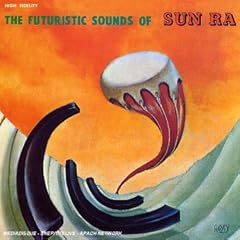
Sun Ra Arkestra: The Futuristic Sounds of Sun Ra


Bob Burnett: 1961 was a transitional time for the Sun Ra Arkestra. The group made the jump to New York City after spending 1954-61 in Chicago. They also signed with the Savoy label and the first studio outing in October found them creating The Futuristic Sounds of Sun Ra. This album is an excellent port of entry to the Sun Ra Arkestra if you've been looking for a way to approach the huge archive and sometimes difficult music of one of the 20th century masters. The Futuristic sound reflects the highly bop-laced, tightly arranged and executed music the seven piece ensemble was making at the time; it's sideways Ellington--and I mean that in a very reverent way. Sun Ra's piano grooves with fat, rolling chords and meditative solos. John Gilmore plays bass clarinet and tenor sax and is joined frequently in solos and heads by Marshall Allen's flute, alto sax and handcrafted morrow, an instrument that consisted of a clarinet mouthpiece joined with a wooden flute. Pat Patrick's baritone sax also plays a major part. There's terrific percussion--performed en masse by the Arkestra--most notably "The Beginning" and "New Day" where strains of paleolithic Stravinsky meet the pulse of santeria.
The album was produced by Tom Wilson, whose production credits later included The Mothers of Invention's Freak Out!, Bob Dylan's Bringing It All Back Home as well as the single "Like A Rolling Stone" from Highway 61 Revisited and (oh yeah...!!!!) some album called The Velvet Underground and Nico. The Futuristic Sounds... was nicely re-mastered in 2003 and sounds very contemporary.

I call The Futuristic Sounds.. a point of entry into Sun Ra because I personally know the toll it can take if you incorrectly compute your atmospheric trajectory when approaching The Arkestra; you can easily bounce back into space and miss out for years to come. I recall trying to start with Live in Montreux 1976 as a teenager and running away very fast...overwhelmed but luckily unbloodied--however the album remained shelved for more than a decade ....luckily I discovered the Evidence label's deep archive when I was slightly older and somewhat wiser to the ways of Ra and was able to ramp my way all the way into the inner depths of spatial exploration. (albums such as Cosmic Tones For Mental Therapy/Art Forms of Dimensions Tomorrow for example)

Please explore what Sun Ra left; it makes for fascinating and unique listening experiences. I suggest reading through Robert Campbell's discography to gain a deeper understanding of the Sun Ra Arkestra's body of work.

1.29.2008

Sten Sandell Trio+ John Butcher:Strokes


Bob Burnett: Continuing with my fascination with Lisbon-based label Clean Feed, I recently fell under the spell of Strokes. Sten Sandell's piano leads this improvisational outing--along with bassist Johan Berthling (also part of the excellent electronica/ambient/accordion trio Tape) and percussionist Paal Nilssen-Love and added guest saxophonist /electro-acoustic and feedback "player" John Butcher. Strokes is made up of three compositions--two 25+minute extended pieces ("Study" and "Unsteady") make up the main body of the album. Each is unique in its approach to exploration but are rooted in moments of quiet, tense, building energy with subtle shifts in texture and pulse. The separating and advancing factor in this music is the use of electronics and feedback. I am smitten with John Butcher's ability to expand the traditional range of the saxophone by adding new dimensions with the use of feedback usually associated with guitar. His whole sax becomes a sound device--the music "feels" like the entire sax is a contact mic, each touch becoming a new sound creation. Interspersed throughout are electronic squalls and burbles which add wonderfully to the sonic scape. Sandell's piano is clustered, engaged and intense; reminiscent of an expanded, spacious Cecil Taylor.
Granted, this session gets "out" and aggressive at times but that energy is earned; as a listener you are ramped into the intensity--not dropped into it and overwhelmed.

This is a fine work by a group that knows and experiences music beyond "jazz"--you can hear the roots of Cecil Taylor and Evan Parker here but also Sandell's other influences such as Iannis Xenakis, Morton Feldman and Derek Bailey. A highly recommended adventure--it's available as a download on emusic.com.

1.25.2008

iPOD Random Shuffle: Jan 2008


Bob Burnett: Just had the following sequence as the soundtrack for a winter walk in the central Virginia woods.


Trentemoller: "Vamp" (The Last Resort)
Robin Holcomb: "SAAM #1" (John Brown's Body)
Tom Verlaine: "Orbit" (Songs and Other Things)
Fennesz:"Good Man" (Field Recordings)
Antonio Carlos Jobim: "Lamento" (The Man From Impanema)
Sun Ra: "Looking Outward" (The Futuristic Sounds of Sun Ra)
Anthony Braxton/Joe Fonda: "Something From the Past"(Duets)
Wilco: "Walken" (Sky Blue Sky)
Thievery Corporation: "Heaven's Going to Burn Your Eyes" (The Richest Man in Babylon)
Robert Fripp: "NY3" (Exposure)
Ornette Coleman: "Storytellers" (In All Languages)
Eno: "Sky Saw" (Another Green World)
John Cage: ASLSP 6 (Mode Piano Works)

1.21.2008

Chessie:Manifest


Bob Burnett: In early February, the "trainscape" duet of Stephen Gardner and Ben Bailes (aka Chessie) will release Manifest on the Plug Research label, their first album since 2001's Overnight which landed them on The New York Times' Best of 2001 list. Manifest is their fourth full length release--fifth if you count Suburban Shore by Camping--a bossa nova-tinged project they were involved with which was reviewed on c60 about a year ago.

I suppose it would be nice to review a Chessie release without falling immediately into making reference to their being rooted in train-inspired soundscapes......however....that's what they do--- and that's what they do beautifully. Accusing Chessie of making too many "trainscapes" would be like saying Monet painted too many haystacks. Chessie creates music which integrates the feel and pulse of trains with sonic imaginary rail-based landscapes by using a wide range of musical colors. From shimmering guitars to subtle washes, Manifest is a complete album's worth of music; a wonderfully connected listening experience. The meticulous craft of their efforts shines effectively throughout; Stephen's guitar is warm and full, subtle chords mix with a wide range of textures to wash many compositions in lovely harmonies. In addition to the quiet, introspective moments, there are times of melodic (German band) Contriva-inspired popish phrases on Manifest which work wonderfully for me. Go to Chessie's webpage to hear a few Manifest selections. Chessie's myspace page offers a few cuts to listen to from past work--hopefully upon official release of Manifest they'll upload some new choices there too, plus the duo is planning to take Manifest on the road performing live.